
Pictures and Descriptions of NJBA's Meet
at Alex Parubchenko's From Dave Potts
Marshall Bienstocks Tong Demonstration
The Trenton Blacksmith Shop
A Day at Alex Parubchenko's
The Iron Melt
The Day We Fired up the Cupola Furnace and Poured Cast Iron! |
|
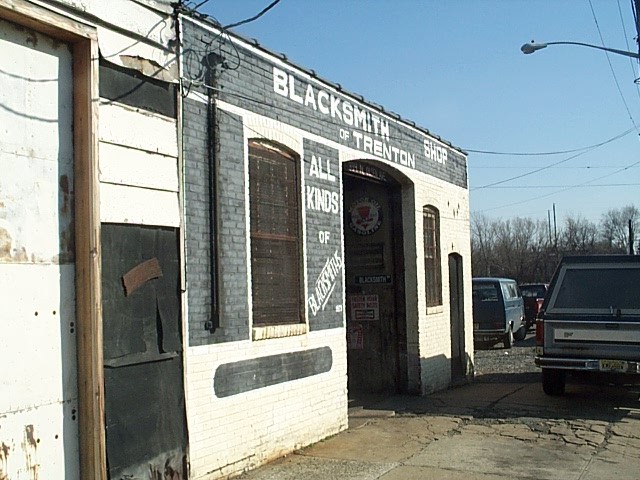
The Trenton Blacksmith Shop has been in operation since the the 1860's according to the collected records. Little is known of the shop prior to 1859, however, since 1860 the shop has been in continuous operation by four different smiths. Doing the math will tell you that they all lived to be a ripe old age. The previous smith worked into his nineties, but ultimately left the business to his son-in-law Alex Parubchenko. Being an entrepreneur, Alex seeks better ways to handle the jobs that come through his door. The absence of local foundries, especially those capable of melting iron, was the impetus for Alex's latest research--building a furnace to melt iron and do some short-run castings. He kindly opened his doors to the New Jersey Blacksmith's Association on a brisk Saturday morning so we could all share in the moment.
| |
 |
|
The Furnace
 |
|
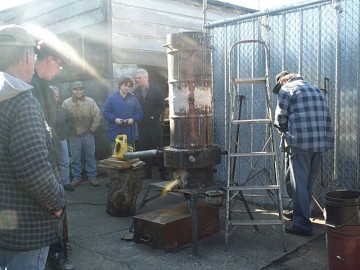
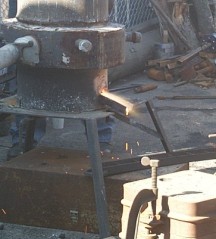
Constructed of two 30-gallon drums, a tuyere with 5 inlet holes, an outlet for molten metal, an outlet for slag, and a trap door clean-out, the furnace was made mostly from odds and ends. The 2.5-inch thick refractory lining, however, cost nearly $200. Any skimping on the lining would have resulted in a meltdown of the furnace walls.
|
 |
|
A charcoal fire was started at 10:00 and coke was added about 11:00. The entire furnace was filled with 1.5" chunks of coke and allowed to burn down. A high speed leaf blower added continuous draft at the tuyere for this operation. At noon, 50 pounds of scrap iron was added through the top of the furnace-- hammer heads, shafts remnants, etc. More coke and a little more air for a few minutes and then the tuyere was opened up so natural convection pulled air through the stack and slowly burned and heated the iron. In 45 minutes the blower was reactivated and the molten iron began to ascend down the core of the furnace. |
 |
|
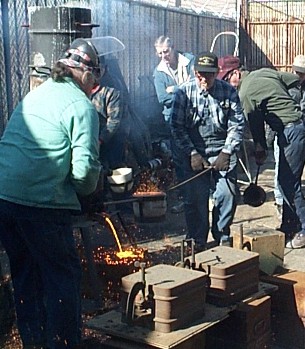
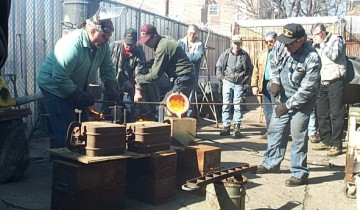
When the flow became liquid enough, a clay plug was rammed into the hole to contain the iron so it could all melt inside the furnace. Alex set his kitchen timer for 10 minutes and cleared the area of onlookers. Soon, the plug was rammed into the furnace and 50 pounds of molten iron flowed into the waiting ladle.
|
 |
|
Alex's team then carefully poured into three awaiting flasks and the final remnants of iron were divvied up into an ingot mold for future melts. As the empty ladle was placed aside, the crowd applauded to congratulate the team for their success. And at that precise moment, Alex's timer rang out-- almost as if it had been planned.
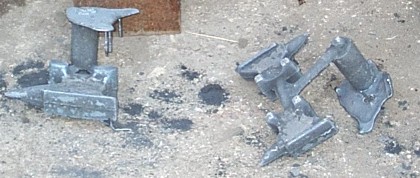
The products of the day were a 10 pound anvil, two four pounders, and an 8 pounder. The remaining 24 pounds of iron is required for gating, risers, and sprues. |
Anvils and gating
Back to top of page
|
|
Marshall Bienstock Forges a Box Hinge |
|
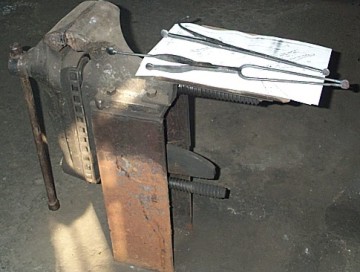
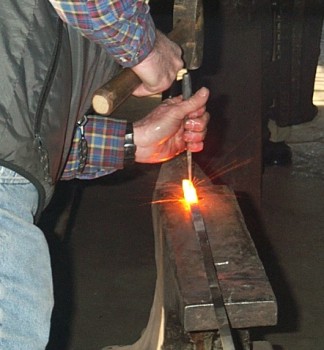
Step One is to form the shoulders of the tongs where the box joint hinge mortise will be formed. Before the mortise can be punched, the piece must have fairly sharp shoulders at both the handle-end and business ends of the tongs. Of course, your material will dictate just how sharp this corner can be. Remember that wrought iron requires long grains of iron to provide strength; too sharp of a shoulder will lead to breakage if you're using wrought iron. |
|
 |
|
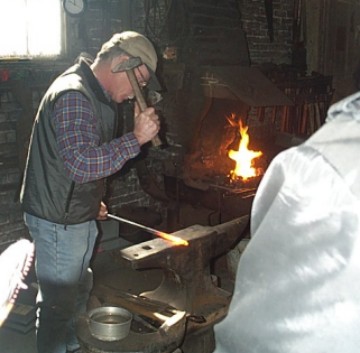
Step Two requires the use of a punch to initially form the mortise for the box joint. Be very careful not to punch through the hot iron. Follow up with a shaped drift to provide the final contour of the tenon. |
|
 |
|
A second option would be to create two halves of the tongs, each fitted with the mortise. A third component would be the tenon portion, ultimately linking both halves. |
|
|
Back to top of page
|
A Glimpse of Alex Parubchenko's
Trenton Blacksmith Shop
Four Generations of Smithies Building Trenton's Tradition |
| |
|
The Delaware River separates Trenton from Pennsylvania and is spanned by a cluster of bridges. One of those structures is emblazened each night with enormous letters lighting the nighttime landscape with "Trenton Makes, The World Takes". While not apparent in today's economy, Trenton was once a hotbed of entrepreneurism, industry, and commerce. Servicing these manufacturers, their employees, and the consumers of this town through those years, was a variety of tradesmen commonly known as blacksmiths.
|
|
The Trenton Blacksmith Shop on Olden Avenue has been in operation since the the 1860's according to the collected records. Little is known of the shop prior to 1859, however, since 1860 the shop has been in continuous operation by four different smiths. Doing the math will tell you that they all lived to be a ripe old age. The previous smith worked into his nineties, but ultimately left the business to his son-in-law Alex Parubchenko. Being an entrepreneur, Alex seeks better ways to handle the jobs that come through his door. These include a variety of historical restorations and replications, household repairs, industrial forgings, and machine components.
|
|
 |
 |
|
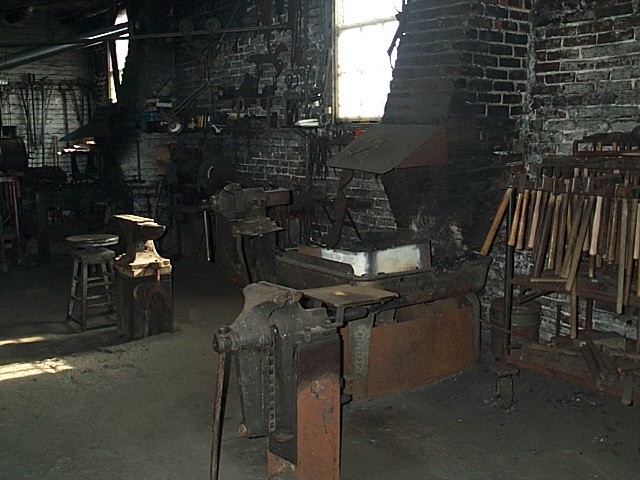
While there may not be the spreading arms of a Chestnut tree outside his shop, there are many features within that fit the traditional blacksmith image. Three jumbo cast iron forges flank one wall, each fed air from a common blower located in the depths of the dimly lit building. The coal that burns in each forge is stockpiled in the rear yard, where dumptrucks can easily replenish his supply. The forge stations are each manned with a stout Fisher double-screw vise, permanately anchored to a supporting post. One forge is equipped with an additional rotating vise made by Chas. Parker in much earlier times. The forge area is dotted with anvils, some by Fisher and some by Hay-Budden, all are moveable to meet the needs of the day's work. Racks and carts also supply each working smith with hundreds of tongs, hammers, punches, and jigs. |
|
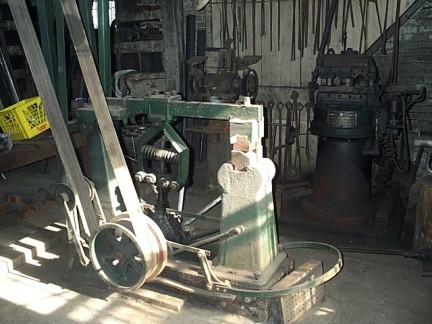
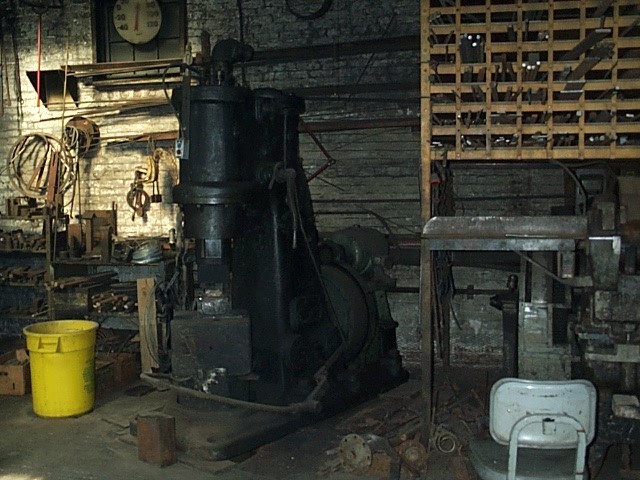
To be sure this isn't your grandfather's blacksmith shop, Alex has outfitted the building with a variety of heavy machine tools, too. A Nazel 3B hammer squats on the North wall next to an eight foot high radial drill. Acorn fabricating tables, multispindle drill presses, iron workers, punches and benders populate additional areas. The back of the shop features a lineshaft driven Hawkeye Hammer, a little-known piece machine tool history.
The second story once housed a wagonmaker's shop and is outfitted with a universal woodworking setup, a single-motor driven machine integrating a 24" bandsaw, a tablesaw, jointer, shaper, horizontle borer and one or two other stations. This machine was designed to be run by several workers performing separate tasks simultaneously. Wagons, carts, and buckboards where hoisted up to this room for repair, or where built here and hoisted down through a wide set of swinging doors. Today the second floor is relegated for storage, but wheels, buggy parts, jigs and patterns hang from the rafters signify its past. |
|
 |
| Back to top of page |
|